BTS in Brussels, 02.07.26
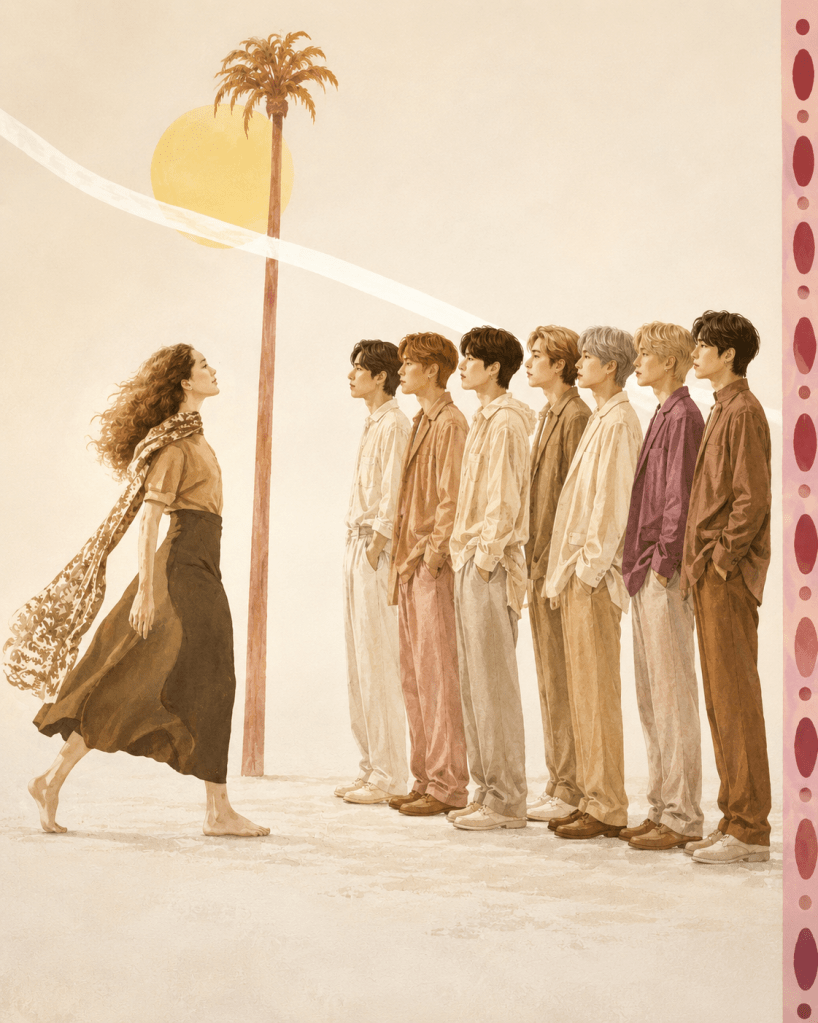
BTS is our love song.
That is what the banner I receive while waiting to enter the stadium in Brussels reads. I hold it tightly and think that perhaps no sentence could better express what I am experiencing.

I am a researcher. My profession consists of questioning human beings who are no longer here, opening drawers that have long remained closed, and attempting to engage in dialogue with the past. It is my way of confronting history. This time, however, I have a strong feeling I’m walking through it myself.
For days I have been accompanied by a moving sense of longing – unusual, difficult to explain. I am happy to return to the Belgian capital, yet even before departing, I know that the Brussels awaiting me will be different from the one I remember.
At the airport, in Turin, I meet the first ARMYs[1]. The plane is, quite literally, ours. I find myself exchanging smiles, opinions, and acts of kindness with complete strangers who will become only the first of many. A temporary community that will accompany me for four days, and one to which I will always be able to return through memory.
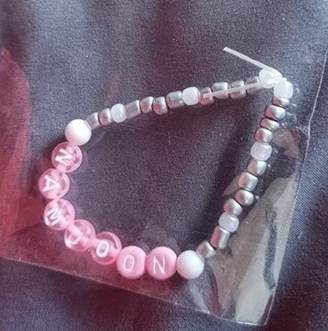
After landing, wearing the bracelet I received before boarding – bearing the name of my bias, Namjoon (RM) – I reach my first destination: the Arthur Rimbaud Hostel in Charleroi. Nomen omen, I think.
My roommate is French and has just returned from the first Belgian stop of the tour. We spend the night exchanging impressions, emotions, and advice for the following day’s concert. When dawn arrives, we part with the same simple, unanswered question: What kind of magic do these seven men possess, and why does it work so powerfully on all of us?
A spell strong enough to make me sleep in a hostel for the first time in twenty-five years. After all, anyone fortunate enough to secure a ticket only fifteen days before a concert of this magnitude quickly discovers that travelling through history can ultimately be summed up in a single word: overbooking.
The following day is made up of railway stations, connections, and trains. As the concert draws nearer, everything takes on a different intensity.
To leave more room in my suitcase, I have not brought any books, and this is unprecedented. I did so deliberately because I wanted to rediscover an old pleasure: talking to strangers. A difficult exercise in everyday life, yet one that becomes surprisingly natural when BTS is the common language.
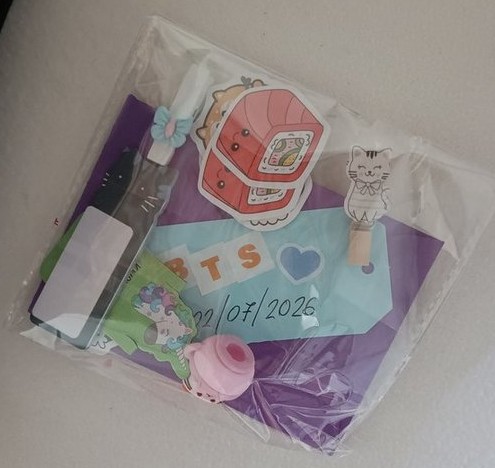
During the train journey I meet two other Italian ladies from Abruzzo. We spend our time talking about literature, and I cannot resist mentioning my lifelong literary bias: Gabriele d’Annunzio[2]. Before we part, they hand me an envelope. I immediately sense that it will become the symbol of this journey.
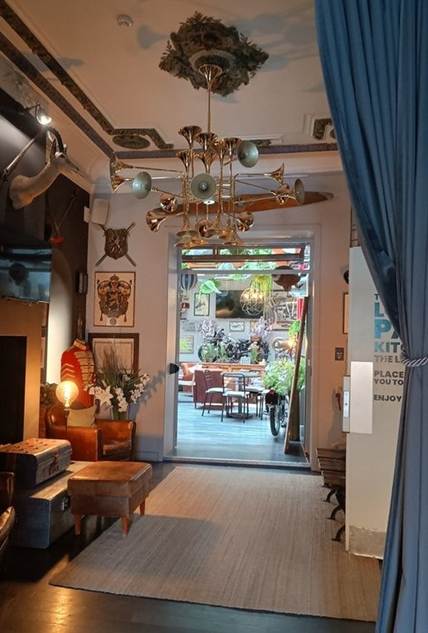
I then arrive at my second hostel, The Legacy, a historic residence dating back to 1873, whose interiors form a mosaic of artistic inspirations that can only be described in one word: eclectic.
The concert is now approaching. Everywhere I look, the streets are filled with shades of purple, red, and white: coordinated outfits, ribbons, photocards, and lightsticks. I have been attending concerts for as long as I can remember, but I have never witnessed anything remotely like this.
The room I share resembles a miniature map of the world. There are people from Finland, the Philippines, Spain, and Mexico. We could illuminate the room with nothing more than the energy we carry within us. We talk constantly, yet with a sort of shared solemnity. After all, we are all counting down to the very same destination: the Roi Baudouin Stadium.
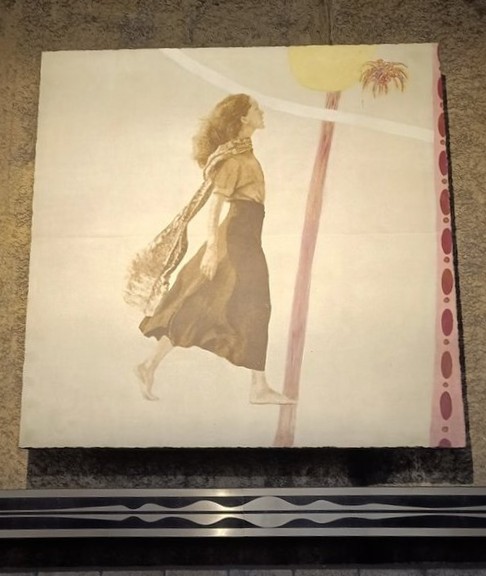
The only true distraction I encounter along the way is a work of art installed in the final metro station before the venue. It is luminous, unusual, profoundly symbolic. For a brief moment, it feels as though it had been created specifically to welcome us all. [See the end of this article.]
During the ten minutes which separate me from the entrance, I receive another wave of gifts, including the very banner I mentioned at the beginning. Looking at it, I immediately think of a t-shirt I bought during my first trip to Belgium, in 2003. Printed across it is a sentence I still wholeheartedly believe: The world needs more love letters. And BTS are the closest thing to a universal love letter one can picture.

Since their debut, they have been the subject of hundreds of studies examining their symbolism in the finest detail, all in an attempt to grasp the essence of their artistic vision and their impact.
As for me, I imagine them as the seven fragments of a broken plate restored through the Japanese art of kintsugi. Could you explain why those veins of gold, born from fracture, move you so deeply? Probably not. And that is precisely why you keep searching for them. The answer lies in the persistence of the question itself.
That is why the final two hours of waiting seem to pass both slowly and at breathtaking speed. Excitement is everywhere. We are a joyful, generous audience, eager to return every ounce of the affection we receive.
Then comes the red smoke, and it is a moment beyond description. There they are!

BTS embody the Gesamtkunstwerk—the total work of art—in constant dialogue with their audience. The mutual love between artist and public is tangible, and tonight offers perhaps its clearest demonstration. When the lights go out, the silence lasts only an instant. Then comes the explosion.
Thousands of Army bombs transform the late afternoon into a luminous constellation, while the entrance of the seven members is greeted by a roar powerful enough to reverberate throughout the entire stadium.
For nearly three hours, I become part of the most extraordinary show I have ever witnessed. It is time for Jin’s unmistakable humour, saluted by the sharp intelligence of Suga, which gives way to the breathtaking energy of J-hope. Then comes V, whose effortless command of both audience and cameras borders on the uncanny, together with the astonishing virtuosity of Jungkook and the perpetual grace and purity of Jimin.
“That’s only six,” you might say.
You are right. The seventh member is RM, and he is the fundamental reason I am here tonight. Because of this, I invite you to discover our leader in an article I devoted entirely to him: https://www.meer.com/en/106962-kim-nam-joon-and-the-art-of-attention
As the concert gradually draws to a close, no one is truly ready to leave. ARMY continue singing through the final farewells, as though no one wishes to break the spell of a place where all of us can recognize ourselves as part of the same story.
I return to the metro station and once again encounter the artwork that had caught my attention on my way there. This time I can devote a few more seconds to it before being swept away by the crowd.
The connection with the final song performed that evening, Into the Sun, is immediate.
The woman portrayed in the artwork walks toward a brighter future.
And so do we.
She walks alone.
We, instead, are accompanied by seven stars.
Emanuela Borgatta Dunnett
Transcendance Platform
Created in 1985 for the Houba-Brugmann metro station in Brussels, Transcendance Platform is one of the most original examples of the integration of public art, cinematic language, and monumental painting. The work emerged from the collaboration between two distinguished Belgian artists: Raoul Servais (1928–2023), the celebrated filmmaker and pioneer of animated cinema, and Pierre Vlerick (1923–1999), a painter renowned for his exploration of light, colour, and the female figure. The result is an artistic intervention capable of transforming a place of everyday transit into a space for contemplation and reflection.

The work unfolds along the station walls through large concrete-polyester painted panels and an extended stainless-steel frieze. Its composition originates from a sequence filmed on 35 mm motion picture film. Along one wall, fifteen large “frames” analyse the movement of a woman skipping, breaking her gesture down into a succession of still images. On the opposite wall, seven triptychs offer an alternative interpretation of the same movement, transforming it into a freer, more rhythmic, and almost abstract vision. Running beneath both sequences is a stainless-steel band that visually evokes the soundtrack of a strip of film, completing the dialogue between image and sound.
What makes Transcendance Platform especially fascinating is the way it transcends the boundaries between artistic disciplines. Servais transfers his experience as an animation filmmaker into painting, demonstrating that movement can be suggested even through static images. Time—the essential element of cinema—is here expanded and made visible. Rather than watching a projection, the visitor physically walks alongside the sequence of images, becoming part of the artwork’s own rhythm.
Pierre Vlerick, in turn, brings a powerful painterly dimension to the composition. His mastery of colour and sensitivity to light transform what could have remained a simple study of movement into a poetic narrative. The female figure—a recurring subject throughout his artistic production—does not appear as a realistic individual, but rather as a symbolic presence suspended between dream and reality. The painting does not merely depict a body in motion; it suggests an ongoing process of transformation, becoming almost a metaphor for the human condition.
The very title, Transcendance Platform, invites an interpretation that reaches beyond its formal qualities. The “platform” naturally evokes the metro station itself—a place of waiting and passage—while “transcendence” suggests the overcoming of physical and material limitations. Every journey thus becomes a metaphor for inner transformation: the movement of the body represented on the walls mirrors the existential journey of those who pass through the station each day.
It is no coincidence that the work was installed in Houba-Brugmann station, adjacent to Brugmann Hospital. The artists conceived the project as a social and humanitarian message. The sequence of movement, the vitality of the female figure, and the continuous references to transformation all become symbols of renewal, healing, and hope for those who live in the neighbourhood or visit the hospital. Art thus becomes an integral part of the urban experience, offering a moment of pause and imagination within a place normally associated with haste and everyday commuting.
More than forty years after its creation, Transcendance Platform has lost none of its expressive power. The work demonstrates how public art can move beyond mere decoration, becoming instead a means of dialogue between artistic languages and among the people who inhabit these spaces every day. Through the collaboration of Servais and Vlerick, cinema, painting, and architecture merge into a single visual narrative.
[1] https://www.usbtsarmy.com/army-dictionary
[2] Go follow: https://www.instagram.com/livingthesanctuary

