Eleganza, confine e desiderio di modernità
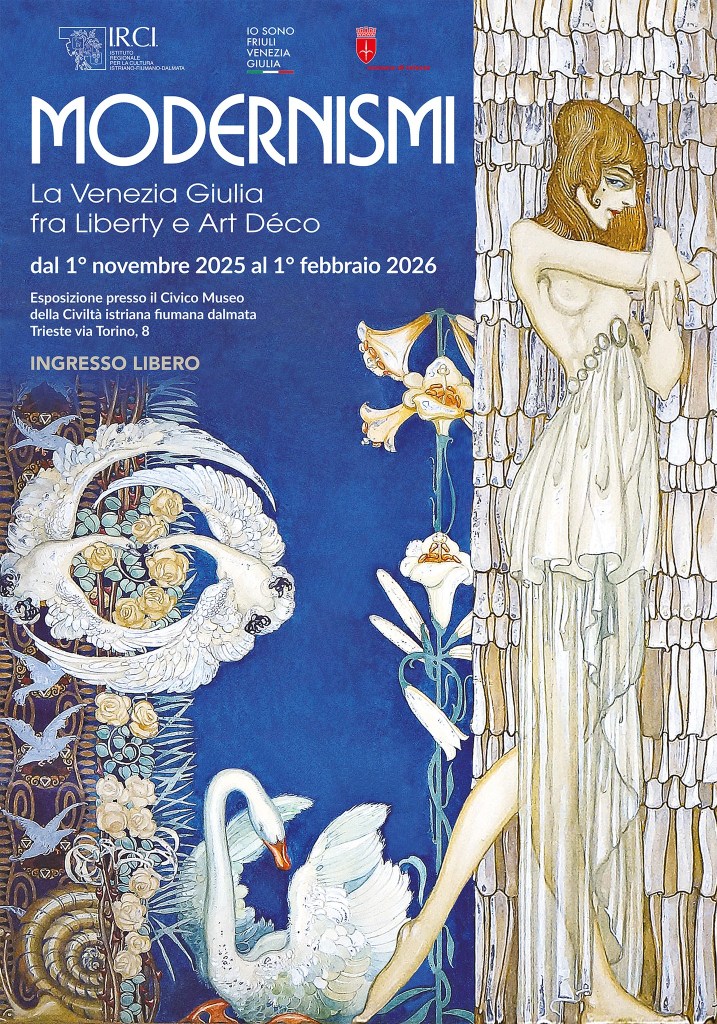
Modernisms. Venezia Giulia between Liberty and Art Déco – Elegance, borders, and the desire for modernity
Some exhibitions tell the story of a style; others tell the story of a way of being in the world. Modernisms. Venezia Giulia between Liberty and Art Déco, currently on view at the IRCI in Trieste, undoubtedly belongs to the latter category. More than a survey of two of the most beloved decorative movements of the early twentieth century, the exhibition unfolds as a layered narrative of desire, identity, and transformation, set within a borderland that has always looked beyond itself.
The exhibition spans the period from the late nineteenth century to the 1930s, tracing an era in which aesthetics were anything but superficial. In Venezia Giulia—both a geographical and cultural crossroads—Liberty and Art Déco are not merely imported styles; they are absorbed, reinterpreted, and made intimate. This is where the exhibition’s strength truly lies: in presenting modernity not as a fixed canon, but as something fluid, hybrid, and strikingly contemporary.
From the outset, the exhibition design signals a shift in perspective. This is not a conventional museum display, but a carefully constructed dialogue between applied arts, design, sculpture, graphic works, painting, and everyday objects. A curatorial choice that mirrors the spirit of the period itself, when art entered domestic interiors, clothing, and daily rituals, transforming life into a conscious aesthetic project.
Liberty here is not merely floral or sinuous. It expresses a tension toward the new, a fascination with line, with the female body, with nature abstracted into rhythm and ornament. The influence of the Viennese Secession is evident, yet never derivative. Trieste, Pola, Fiume, and Gorizia absorb Mitteleuropean impulses and translate them into a distinct visual language—restrained, elegant, experimental without excess. It is a form of beauty that does not shout, but quietly seduces.
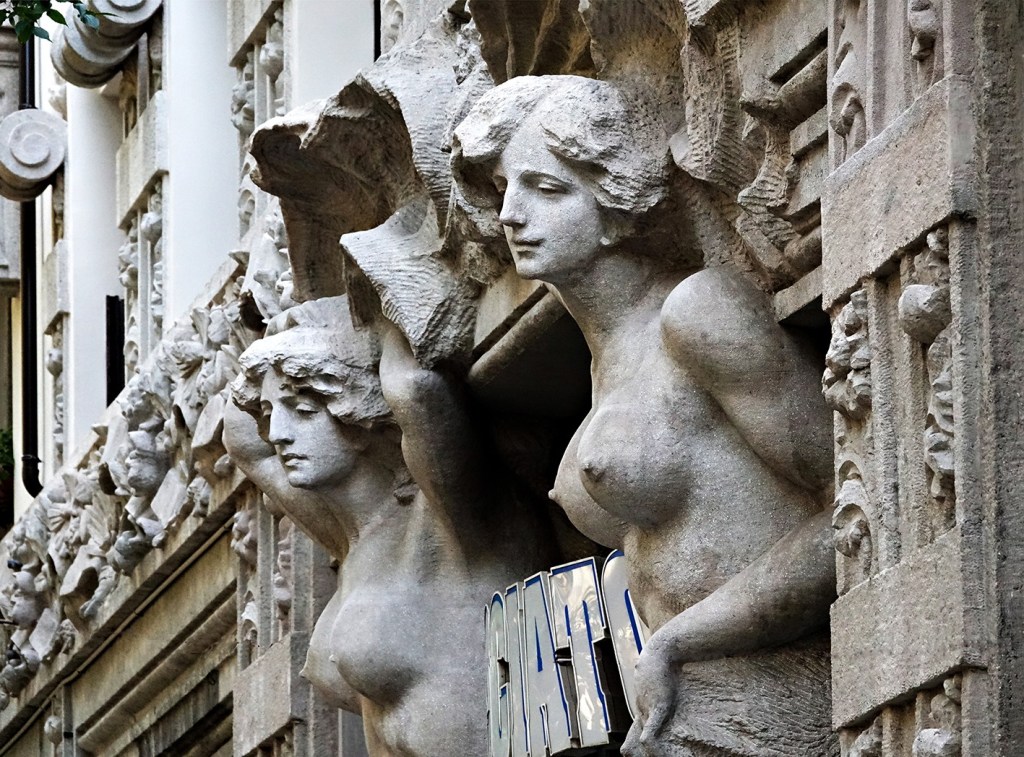
As the exhibition moves into Art Déco, the narrative sharpens. Curves tighten, surfaces become streamlined, ornament gives way to geometry. This is a style fully aware of the modern world—one shaped by industrial progress and the aftermath of war. Here, luxury is no longer romantic but graphic, controlled, almost cinematic. Importantly, the exhibition presents this transition not as a rupture, but as a natural evolution of the same desire for modernity.
The objects on display—glassware, ceramics, bronzes, plates, furnishings—evoke a cultivated bourgeois everyday life, attentive to international trends and visual refinement. Works by Lalique, Lenci, Hoffmann, and Chiparus sit alongside local and regional productions, revealing taste as a shared, transnational territory. Influences circulate quickly, freely, shaping a collective aesthetic consciousness. It is a dialogue that resonates strongly today, at a time when fashion, design, and art once again dissolve rigid boundaries.
Particularly compelling is the presence of painting and graphic art by figures such as Vito Timmel, Rudolf Kalvach, and Argio Orell, whose works convey the emotional and intellectual climate of a generation suspended between dream and unease. Their images engage in a quiet conversation with the decorative objects around them, suggesting that modernity is not only a matter of form, but also of psychological state.
The exhibition also functions as a reflection on the identity of a region often discussed in historical or political terms, but rarely explored through the lens of taste and aesthetics. Here, Venezia Giulia emerges as a laboratory of style—a place where modernity took shape not through imitation, but through interpretation. A border that does not divide, but blends.
For a readership like that of Meer Magazine, accustomed to reading visual culture as a complex system of signs, Modernisms offers a valuable reminder: fashion, design, and art never arise in isolation. They are born from places, social tensions, and collective aspirations. And it is often in periods of transition—perhaps especially in those moments—that creativity finds its most fertile ground.
Ultimately, this exhibition is not merely a homage to two iconic styles, but an invitation to rethink modernity itself. A modernity composed of details, materials, and gestures—one that speaks to us today with unexpected clarity. Elegant without nostalgia, intellectually rich without distance, Modernisms. Venezia Giulia between Liberty and Art Déco is an essential stop for anyone looking to the past to understand the present—and perhaps imagine the future.
Emanuela Borgatta Dunnett
 Manu Writes and Reviews