Museo d’arte Mendrisio
30th March – 6th July 2025
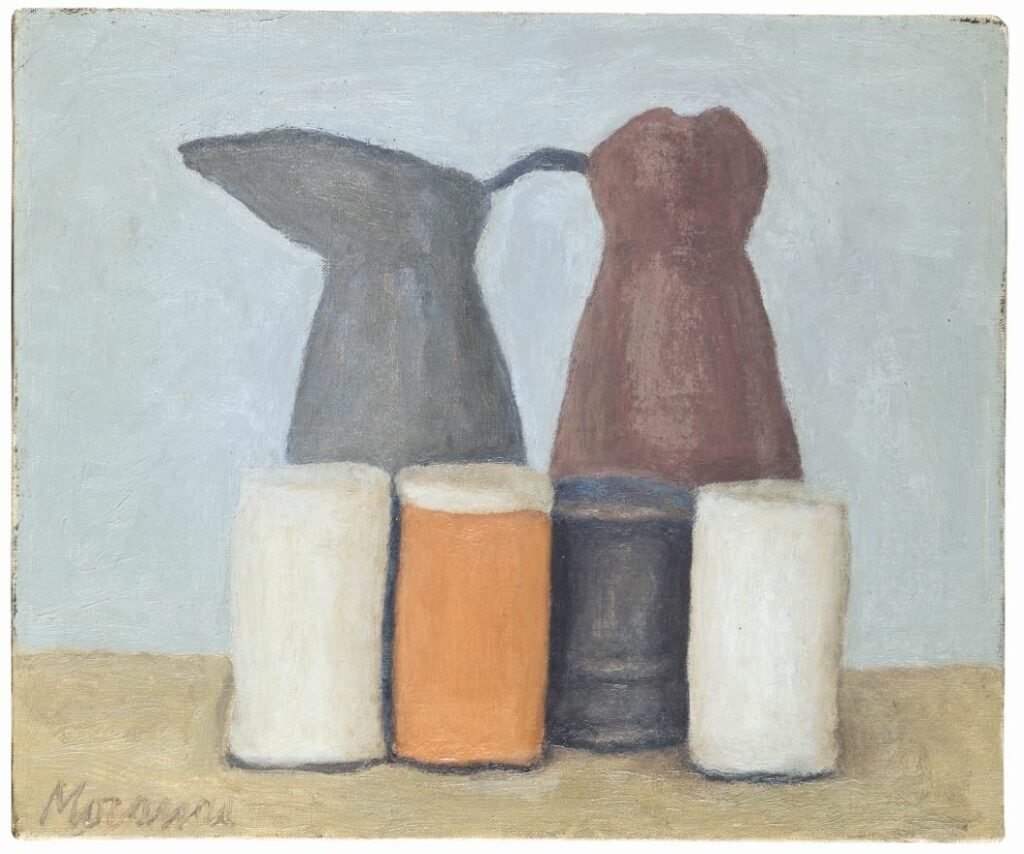
Morandi – Museo d’Arte, Mendrisio
The exhibition Una storia di arte e di poesia opens on 30th March at the Museo d’Arte in Mendrisio and establishes a dialogue between the artistic gesture and the words of eight ‘critics’ by placing quotations from their writings alongside the works on display in a poetic and formal adherence relevant to the historical context.
Italian art-historical criticism of the 20th century had in Roberto Longhi a fundamental and charismatic figure; an indispensable figure for a generation of ‘art lovers’ – some by profession, some by passion – from the late 1930s onwards. Longhi was a figure studied for his exceptional qualities as an art historian, but also for his very high qualities as a writer. In one way or another, all of the eight central figures animating the exhibition draw on his lesson: the exhibition takes its cue from Longhi’s well-known principle, ‘make criticism return, together with art history, to the heart of a literary activity’.
The texts translate into words the works of a large group of artists and also lead us to an interweaving of situations that – with the grafting from outside of favourite artists – restores the ‘spirit of the times’. All eight protagonists collaborated with newspapers, magazines, catalogues, and their strong interest in visual art has already been explored case by case through various publications that give a complete profile of their activities in the field of criticism, with their particular way of approaching the contemporary artist and his work: some devoted more to true art criticism, others taking on the role of connoisseur while remaining faithful to their literary ground. In search of that ‘equivalence’ between writing and image, of a ‘parallel’ or ‘mirroring’ between poetry and painting. Their involvement in art criticism varied in degree: Francesco Arcangeli, Roberto Tassi and Giovanni Testori experienced it as their main activity, while for Attilio Bertolucci, Francesco Biamonti, Dante Isella, Giorgio Orelli and Vittorio Sereni that aspect was secondary. Despite their peculiarities, together they represent the mirror of a time, and this is also thanks to the bonds of friendship between them and the interest, which often united them, for the same artists.
The main road of the exhibition is the one that leads from the Informal art of the 1950s to the new Figurative works of the 1980s, but the exhibition also gives space, due to the quality of the writings, to some precursors and extremely differentiated formal directions. All eight protagonists are linked to traditional techniques: painting and sculpture; all eight, with the exception of Biamonti, are linked to the same geographical area, from Lombardy to Emilia, and to their Romanesque roots; all eight are linked to contemporary artist friends from the Po Valley region: Morlotti, Francese, Afro, Della Torre, Valenti, Melotti, Ruggeri, Moreni, Mandelli, Dobrzanski, with one glance, however, at the due exceptions such as Burri or Leoncillo, Guttuso or Guccione, and another towards the reference ‘beacons’ of the time outside Italy: Bacon, Giacometti, Sutherland, De Staël, Fautrier, Wols, Klee, Hartung, Varlin, Mušic, up to Testori’s Neuen Wilden.
The artist on display are phenomenal: Francis Bacon, Afro Basaldella, Giovanni Bianconi, Filippo Boldini, Giuseppe Bolzani, Luigi Broggini, Alberto Burri, Massimo Cavalli, Giancarlo Cazzaniga, Alfredo Chighine, Enzo Cucchi, Enrico Della Torre, Filippo de Pisis, Martin Disler, Edmondo Dobrzanski, Jean Fautrier, Renzo Ferrari, Gianfranco Ferroni, Rainer Fetting, Franco Francese, Gabai, Sergio Gagliolo, Federica Galli, Alberto Giacometti, Giovanni Genucchi, Piero Guccione, Renato Guttuso, Hans Hartung, Paul Klee, Pierluigi Lavagnino, Leoncillo Leonardi, Enzo Maiolino, Mario Mafai, Pompilio Mandelli, Mario Marioni, Roberto Matta, Carlo Mattioli, Fausto Melotti, Ubaldo Monico, Giorgio Morandi, Mattia Moreni, Ennio Morlotti, Zoran Mušic, Mario Negri, Giancarlo Ossola, Giovanni Paganin, Gianriccardo Piccoli, Tino Repetto, Sergio Romiti, Piero Ruggeri. Ruggero Savinio, Pierino Selmoni, Vittorio Sereni, Nicolas de Staël, Graham Sutherland, Mara Taggiasco, Vittorio Tavernari. Sandra Tenconi, Italo Valenti, Varlin, Wols.
The introductory essays in the catalogue are signed by Simone Soldini – who is also responsible for the choice of critical texts accompanying the works and those in the appendix – by Claudio Spadoni and Antonio Rossi. The introductions to the eight sections are written by Clelia Martignoni (Sereni), Renato Martinoni (Isella), Matteo Grassano (Biamonti), Silvia Trasi (Bertolucci), Ariele Morinini (Orelli), Giuseppe Frangi (Testori), Roberto Bazzocchi (Arcangeli), Ivo Iori (Tassi).
Emanuela Borgatta Dunnett
 Manu Writes and Reviews