A personal journey
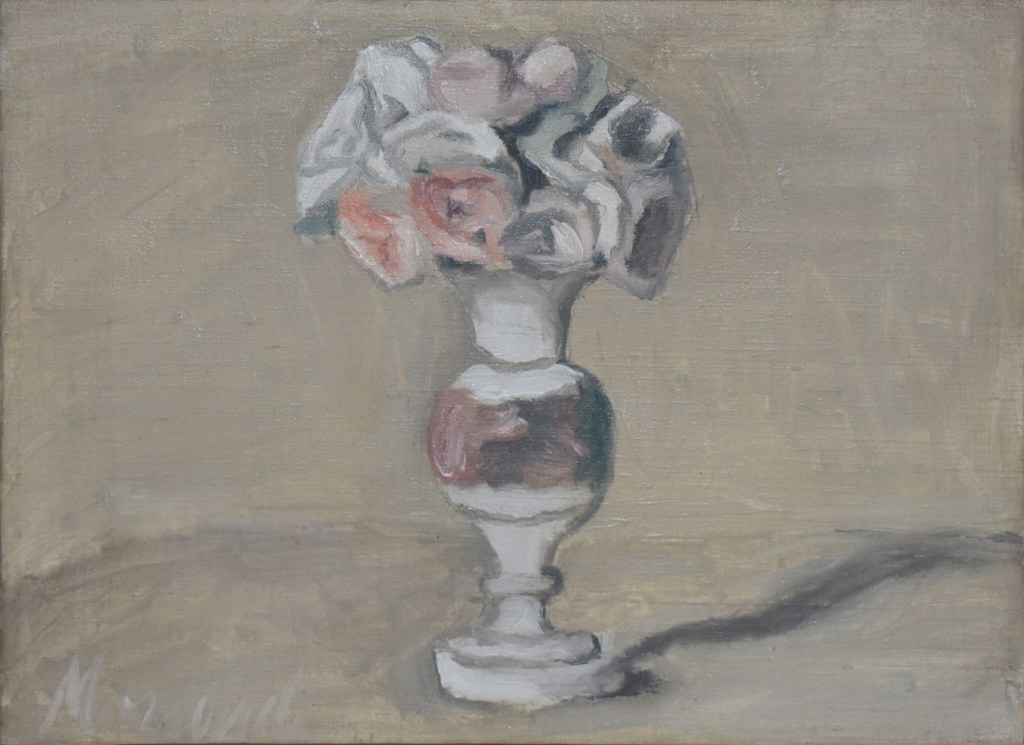
Giorgio Morandi, Fiori (Flowers, 1949) Collection of RM
@SFMOMA
A Rose Is a Rose Is a Rose
This exhibition broke my heart. There was not a single sense that I did not feel awakened and engaged as I made my way through the galleries of SFMoMA in San Francisco on the day of the press preview of RM x SFMoMA: Between You & Me.
I have written articles (and will write more) about what makes an exhibition of this kind so distinctive in the West, but this is not the place to explore the wonders on display. Rather, this is an attempt to understand why those rooms continue to live so vividly within me. After almost thirty years of visiting and writing about exhibitions, what happened in San Francisco that was so profound as to make me think this was one of the most beautiful and intense exhibitions I have ever seen?
My admiration for RM made me fear that I might have my guard up too high; I had to resist the temptation to give in to a preconceived notion: I love what he creates, therefore I will love what he collects. And yet, I had to lay down my arms almost as soon as I entered. The moment I stepped inside, I found myself confronted with an autonomous corpus, different in form and substance from anything I had imagined during the two years since the exhibition was announced.
RMxSFMoMA is not simply the display of a personal collection (which would be interesting enough in itself). Rather, it has been constructed, down to the smallest detail, to merge with the collector himself. The rooms are RM, or perhaps, more accurately, Kim Namjoon. They are so in the way they express his taste through curation; in the almost surgical refinement of the words he uses in the audio guide he narrates himself, accompanying visitors throughout the exhibition (I want it formally recorded that this is the first, and I believe the last, audio guide I have ever listened to with interest from beginning to end: I detest them!); in the playlist he has selected; and in the creation of environments that seek to redefine the very concept of home while remaining faithful to it.
Given the possibilities available to us today, it is a real shame that the exhibition cannot also be experienced online by those unable to visit in person, or that no catalogue has been produced. Of course, the experience would not be the same, but I am almost mathematically certain that Namjoon considered this during the installation process and tried to find a way around it. In this sense, sharing accompanying images and sounds with a wider audience is an act of collective love. A dialogue conducted through multiple languages which perhaps answers my initial question: what moves me to tears and draws me back within those walls, even now that I am thousands of miles away?
SFMoMA’s collection was the starting point of my day at the press preview on 29 September. A wonderfully heterogeneous legacy, it enters into a silent yet resolute dialogue with the seventh floor, where the temporary exhibition is installed. It is almost as though a familiar universe were hosting a parallel one within itself.
As I move through the galleries, I find myself wholeheartedly agreeing with Namjoon when he tries to express how difficult it is for him to describe what drew him to particular works of art, referring especially to the artist who seems to be closest to his heart: Yun Hyong-keun. I, too, feel at a loss when I try to translate onto the page this mystical bond that continues to connect me to what I have seen.
It is as though certain works were friends I never knew I had. How could your existence not seem both small and, at the same time, immense when you pause to consider the traces left behind? Details made up of unfinished sentences, imaginary faces, and a constant blue that seems to engulf you in questions even as it offers you answers.
During the press conference, RM used a verb to describe himself: floating. Such a gentle word, and yet such a weighty one; devoid of concrete boundaries, undefined. I understand the difficulty of constantly feeling at the mercy of shifting currents. Or rather, I understand it from a purely personal perspective, because when it is art that floats, free from contours and unencumbered by constraints, it is precisely within that ineffable freedom that art converges with life and becomes indistinguishable from it, giving our existence its meaning.
Imagine rooms you can decipher as you please. Like great works of literature, the works on display remain open to your interpretation. You find yourself in a dimension you have never inhabited, yet you could walk through it with your eyes closed, because it is the space itself that guides you, in an extraordinary play of mirrors with the host. “A rose is a rose is a rose,” Gertrude Stein declared. For RMxSFMoMA, however, we might say that the exhibition is RM, and RM is you, in a perfectly orchestrated virtuous circle.
There is, in fact, an undeniably sophisticated construction at work here. It begins with a blue that is both diurnal and all-encompassing, passes through the transparencies of water, and unfolds along a path that continually crystallises it. We cannot touch it, but we can sense it in the eternal flowers, the broken curtains, and the silences we are invited to fill. Meanwhile, day gives way to dusk, and the colours lead us back to the earth, before carrying us onwards into nocturnal spaces.
As I make my way towards the exit, I long to stay. I am eager to share my journey with Namjoon, yet conscious that I do not need to, because where the boundaries between collection, collector, and visitor dissolve, a rose is a rose is a rose.
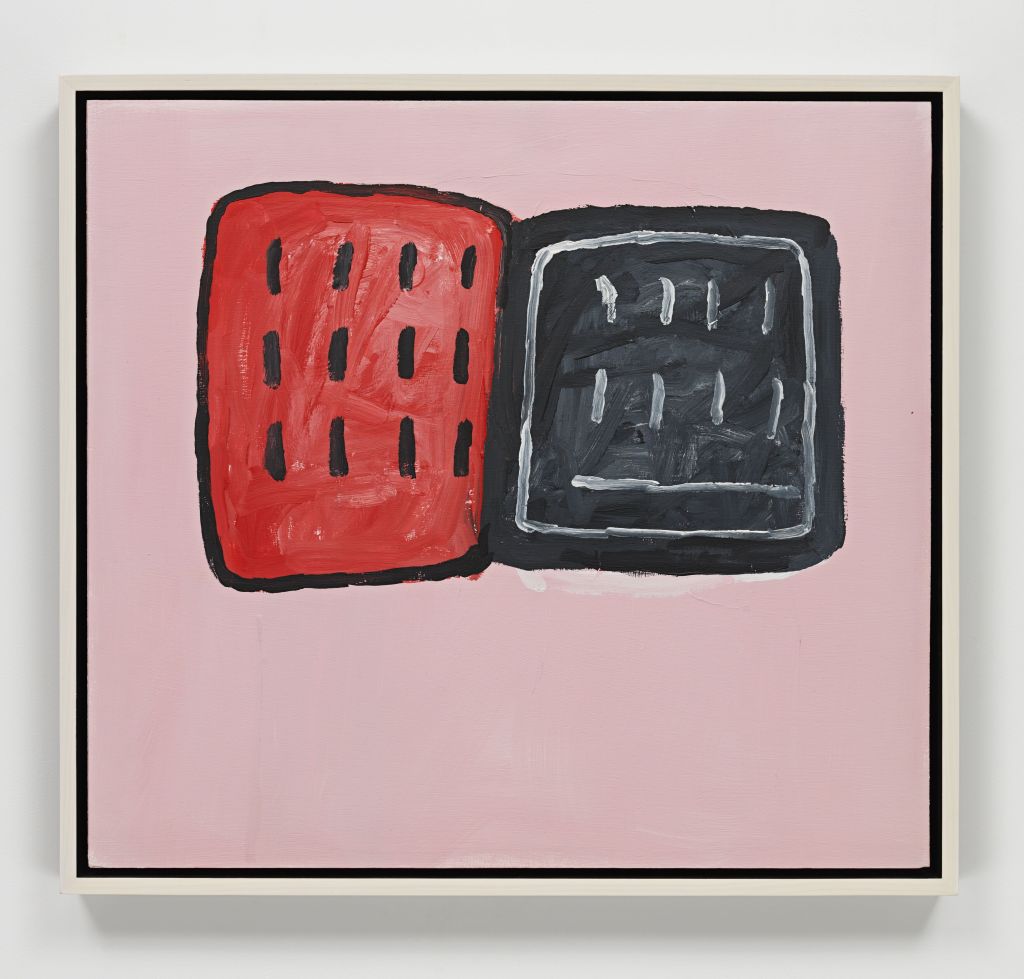
Philip Guston, Untitled, 1969 – Collection of RM @SFMOMA
Emanuela Borgatta Dunnett

